
OTC vs. Prescription Medicines
What’s the difference — and why does it matter?
Walk into any pharmacy and you’ll see two very different categories of medicines side by side – some sitting openly on shelves, others stored behind the counter and dispensed only with a doctor’s note. There is a real reason for this difference. As a Pharmacist one of the most common questions I get asked is: “Why do I need a prescription for that?”
At its core, a Drug is a bioactive substance intended for use in the diagnosis, cure, mitigation, treatment, or prevention of disease. The boundary between OTC and prescription (Rx) medicine is defined by risk management: OTC medicines treat mild, common symptoms and are safe for self-use — while prescription medicines need a doctor’s supervision because they carry higher risks. Either way, every medicine deserves to be taken seriously.
While both categories aim to improve your health, they operate under different levels of professional oversight and risk. Here is how they compare:
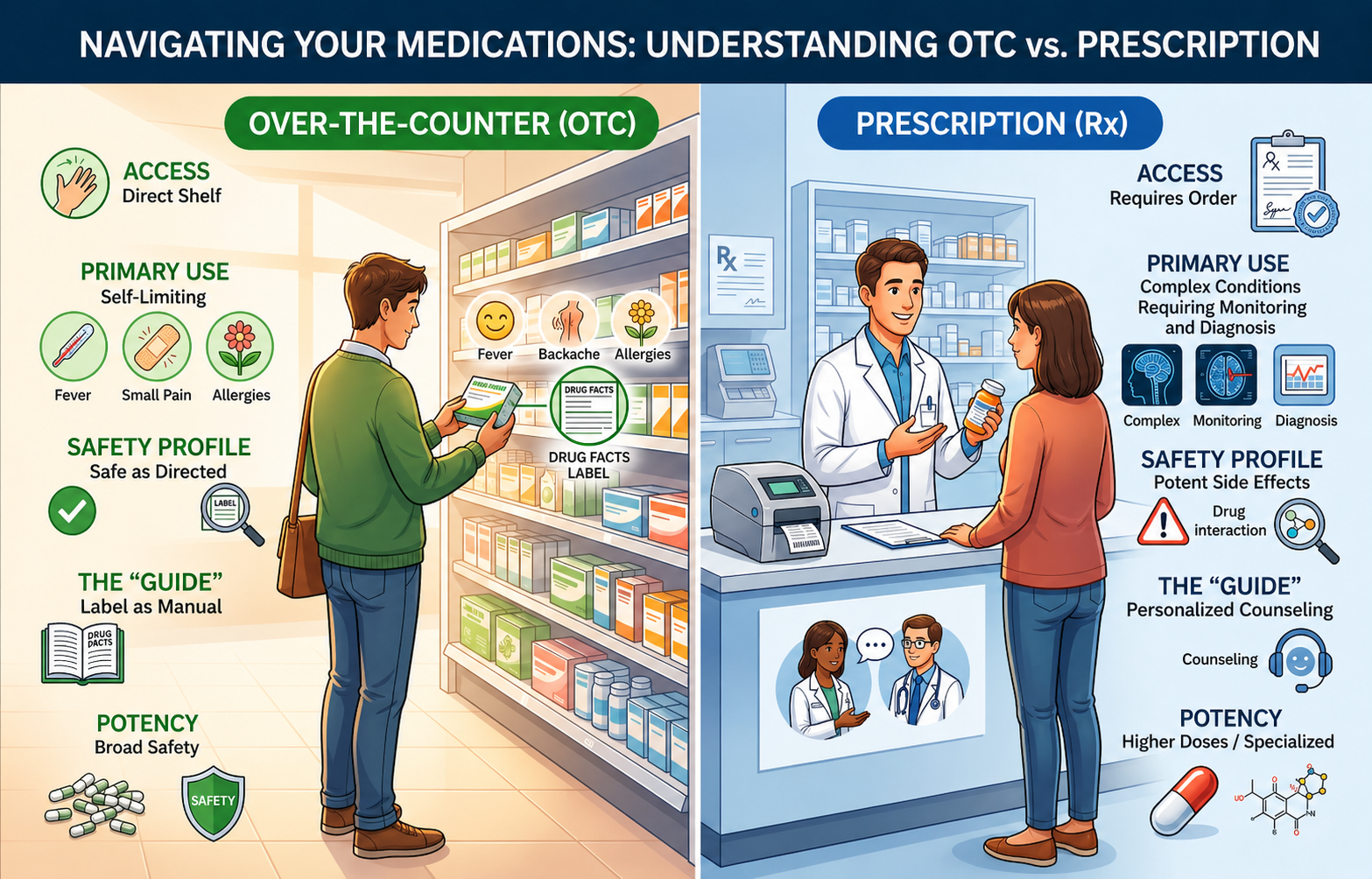
The history of over-the-counter medications stems in the early 1700s, where the landmark Rose Case in Britain broke the medical monopoly, allowing apothecaries—to both prescribe and dispense. For over 150 years, most medicines were freely available to the public until the 1860s, when drugs prone to abuse were finally restricted. By the 1960s, the Brain Committee implemented a safety measures, moving many potent medications behind the prescription pad to ensure clinical oversight. As our clinical understanding grows, more medications are returning to the OTC aisles to improve patient access. However, many life-altering drugs must remain prescription-only to guarantee the public utmost safety.
The classification of a medicine as OTC or prescription-only is a regulatory and clinical decision based on its risk profile. Some medicines have narrow therapeutic windows — meaning the difference between a helpful dose and a harmful one is small. Others interact significantly with common drugs or have effects that vary by kidney function, liver health, age, or underlying conditions.
In short, the prescription requirement exists to protect you. It ensures a qualified professional has assessed whether that particular medicine is appropriate for your specific situation before you take it.
To help you navigate the aisles more effectively, here is a practical breakdown of the critical details most labels fail to emphasize:
- Ignore the bright branding on the front of the box. Turn it over and read the “Active Ingredient” section. Many OTC brands contain the exact same chemical as the generic version sitting right next to it for half the price.
- OTC meds are for short-term relief. If you’ve been self-medicating for 3 to 5 days and your symptoms haven’t subsided yet, do not double the dose. That is your body’s way of saying it’s time to see a doctor.
If you’re ever unsure whether a medicine is appropriate for you — OTC or prescription — please ask your doctor or pharmacist before taking it. No appointment is needed to speak with a pharmacist, and the conversation could make all the difference.
Medicines are also like tools. Used correctly, they heal. Used incorrectly, they harm. Knowing the difference between OTC and prescription categories is the first step toward using them wisely.
REFERENCES
- Aronson, J. K. (2004). Over‐the‐counter medicines. British Journal of Clinical Pharmacology, 58, 231-234. https://doi.org/10.1111/j..2004.02191.x Cited by: 43
- U.S. Food and Drug Administration. (2017, November 13). Prescription drugs and over-the-counter (OTC) drugs: Questions and answers. https://www.fda.gov/drugs/frequently-asked-questions-popular-topics/prescription-drugs-and-over-counter-otc-drugs-questions-and-answers